 Masterpiece Generator
 Name Generator
Britain's Most Endangered Names
The well-known names almost no one is naming their children.
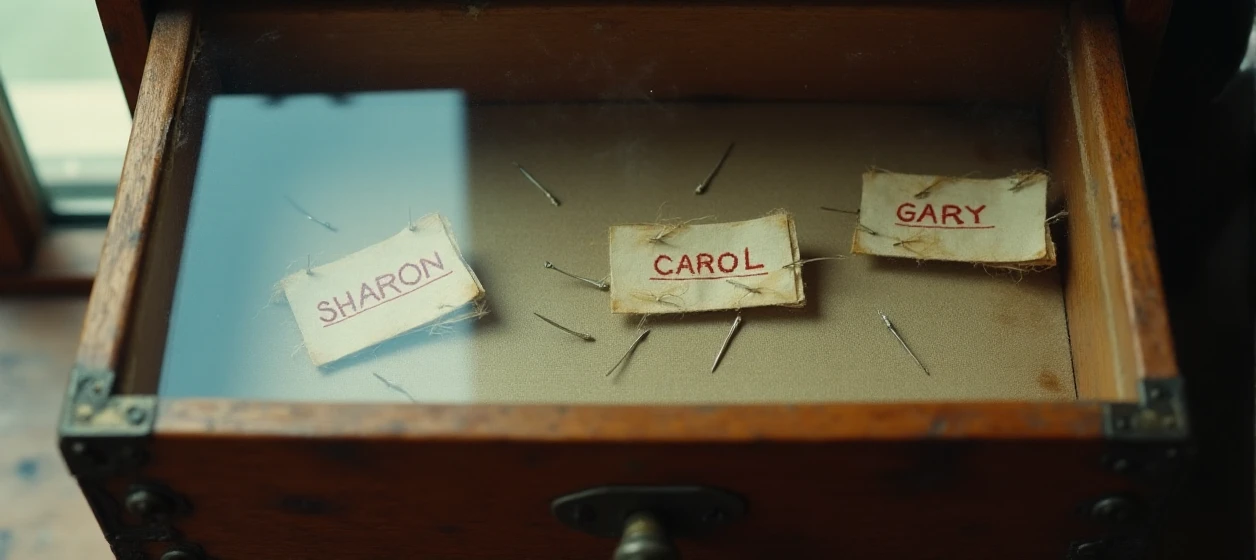
Some names are everywhere and yet about to disappear. You probably know a Sharon - statistically you know several, and at least one Gary, a Karen, probably a Nigel. Now try to think of one in nappies. That gap between the names all around us and the names being written on birth certificates is where this article lives: we've worked out which British names are closest to the edge - the ones with enormous living populations and almost nobody arriving to take over.
Take Sharon. In 2024, there were around 130,000 Sharons in England and Wales, but only fourteen babies got the name. A name that owned the school registers of the 1970s now arrives at a rate of one new Sharon per 8,700 existing ones, and the typical Sharon is 62.
With the ONS 2025 name data release due any day, we visit the names teetering on the brink of extinction.
How do you measure an endangered name?
Counting the last year's registrations only tells you what's rare among babies - by that logic Wolfgang is endangered, but when did Britain ever have Wolfgangs to lose? A name is endangered the way a species is: a big population, ageing, with nothing coming up behind it. So for every name with at least 10,000 recorded births we estimated how many bearers are alive today (births by year, weighted by survival) and divided by the current annual intake. One number: living bearers per new baby.
The most endangered girls' names
| Name | Alive today | Typical age | Babies in 2024 | Living per new baby |
|---|---|---|---|---|
| Carol | 160,000 | 72 | 0 | none registered |
| Tracey | 150,000 | 62 | 0 | 150,000:1 |
| Karen | 200,000 | 62 | 4 | 74,000:1 |
| Pauline | 92,000 | 79 | 4 | 71,000:1 |
| Susan | 420,000 | 71 | 12 | 36,000:1 |
| Janet | 210,000 | 73 | 7 | 27,000:1 |
| Doreen | 50,000 | 91 | 3 | 25,000:1 |
| Maureen | 100,000 | 81 | 6 | 23,000:1 |
| Sheila | 74,000 | 90 | 5 | 17,000:1 |
| Phyllis | 15,000 | 94 | 3 | 15,000:1 |
Carol tops the table with a number that isn't a ratio at all. The ONS hasn't reported a single baby named Carol since 2021 - and Carole with an E vanished years earlier. 2024 makes three unreported years in a row. This means there were fewer than three Carols registered in England and Wales (the ONS doesn't publish names with only 1 or 2 registrations for privacy reasons). So quite possibly no new Carols at all, in a country where 160,000 of them are walking around. On this measure Carol is no longer endangered - she's extinct in the wild, surviving entirely in captivity.
Karen, you'll notice, is at number three, and yes, we know what you're thinking. But pull up her chart and the meme turns out to be a footnote: the decline was twenty years old before the internet decided to put the boot in. The joke didn't kill Karen. It just turned up at the funeral. Susan, meanwhile, manages to be endangered while being one of the most-borne names in the country - 420,000 living Susans, and only twelve babies.
Down at the bottom of the table, the typical Phyllis is 94 and the typical Doreen is 91 - though by the revival rule we're coming to, that may make them next in line rather than lost causes.
The most endangered boys' names
| Name | Alive today | Typical age | Babies in 2024 | Living per new baby |
|---|---|---|---|---|
| Nigel | 100,000 | 62 | 5 | 30,000:1 |
| Barry | 96,000 | 62 | 6 | 29,000:1 |
| Gary | 170,000 | 62 | 8 | 19,000:1 |
| Keith | 130,000 | 70 | 5 | 19,000:1 |
| Leslie | 55,000 | 73 | 10 | 17,000:1 |
| Graham | 140,000 | 63 | 3 | 14,000:1 |
| Stuart | 130,000 | 53 | 9 | 14,000:1 |
| Craig | 110,000 | 43 | 10 | 10,000:1 |
| Geoffrey | 77,000 | 72 | 9 | 9,300:1 |
| Roger | 71,000 | 81 | 10 | 7,600:1 |
Three babies were named Graham last year. There are 140,000 Grahams out there - enough to fill Wembley one and a half times - and last year the entire national production run was a hat-trick.
Now run your eye down the typical-age column on both tables. One number keeps coming up: 62. Sharon, Tracey, Karen, Nigel, Barry, Gary - this isn't a list of names so much as a single year group. The babies of the early-sixties boom got these names by the classful, and that's precisely the problem: a name can be too successful. When everyone in one generation has it, the slump follows a generation later.
One more for the watch list: Craig. Typical age 43 - the youngest name on either table, endangered before his cohort has finished paying off the mortgage.
The ones that came back from the dead
If this is all starting to read like an obituary column, hold on - because the most endangered names of the 1990s have since staged the best comeback tour in British naming history.
In 1998, seven babies were named Ivy. That's half of what the supposedly doomed Sharon scraped together last year. Yet in 2024 there were 1,956 little Ivys, a 279-fold recovery. Ada is even better, because her story comes with a punchline aimed straight at this article: four babies in 1998 - exactly Karen's number today - and now over a thousand a year. Nellie went the whole way, spending years below the publication threshold entirely - fewer than three babies a year, a name with no measurable pulse - and is back to 500. And for the boys, Arthur bottomed out at 129 babies in 1996; in 2024 he was given to 3,368 and sits in the top ten. Click any of those charts and you'll see the same shape: the long slide, the flat decade on the seabed, then straight up.
The rule behind the resurrections is generational, and it's beautifully simple: a name comes back roughly when it stops being your mum's name and becomes your great-granny's. Close enough to feel like heritage, far enough not to feel second-hand.
So no, endangerment isn't a death sentence. But the revival queue moves one generation at a time, and the class of 62 has only just joined the back of it. If the cycle holds, the Sharon revival is pencilled in for sometime around the 2050s. Until then, her 130,000 bearers can enjoy a strange new status: meeting a baby Sharon today is now a rarer event than meeting a baby Ivy was when the Spice Girls were charting.
What to watch when the 2025 numbers land
Three questions for the next release. Does Carol stay off the chart for a fourth year running? Does Tracey - last spotted in 2023, when three babies got the name - join her in the void? And who drifts towards the list next: keep an eye on Stephen, who has 420,000 living bearers, more than any name here, and mustered just 57 babies in 2024.
Every figure above comes from our name popularity pages - ONS birth registrations for England and Wales from 1996 to 2024, modelled estimates back to 1904 and national life tables. You can look up your own name. The room-of-100 odds at the top of each page will tell you, with slightly brutal honesty, whether you're one of a crowd or nearly the last of your line.
Last updated: 5 June 2026
Common questions
What is the most endangered name in Britain?
Carol. Around 160,000 Carols are alive in England and Wales, but the ONS has not reported a single new Carol since 2021 - meaning fewer than three a year, possibly none at all.
Why do names like Sharon and Gary die out?
Saturation. When one generation gets a name by the classful - most of these names belong to the babies of the early-1960s boom - the next generation avoids it, and the slump follows a generation later.
Do endangered names come back?
Often, after about a century. Ivy fell to seven babies in 1998 and was given to nearly 2,000 in 2024; Arthur is back in the top ten. Names tend to revive once they belong to great-grandparents rather than parents.